


Germany Family Reunification: The Documents You Need to Bring Your Family
A practical guide to the documents required for family reunification in Germany — whether you're bringing a spouse, children, or parents, and whether you hold an EU Blue Card or a standard residence permit.

Germany allows residents with qualifying residence permits to bring close family members to live with them. The process — called Familiennachzug in German — is well-established but document-heavy. Whether you are bringing a spouse, a child, or a parent, the documents required depend on who is joining, what type of permit you hold, and whether a language test is required before the visa is issued. Getting the paperwork right from the start reduces delays and avoids the most common reasons for rejection.
Who Can Bring Family Members to Germany?
Not every residence permit in Germany automatically gives you the right to bring family members. As a general rule, the following permit holders can apply for family reunification:
- Holders of an EU Blue Card
- Holders of a Niederlassungserlaubnis (permanent residence permit)
- Holders of a Skilled Worker Visa (Aufenthaltstitel für Fachkräfte)
- Holders of certain other Aufenthaltserlaubnisse (temporary residence permits), depending on the basis and duration
Asylum seekers and humanitarian permit holders have separate and more restricted rules. This guide focuses on the most common situation: reunification for skilled workers and EU Blue Card holders.
Spouse Reunification — Documents Required
The spouse of a German resident applies for a Visum zum Ehegattennachzug (spouse reunification visa) at the German embassy or consulate in their home country. Core documents for the applying spouse:
- Valid passport (valid at least six months beyond the intended period of stay)
- Recent biometric passport photo
- Completed national visa application form (Antragsformular)
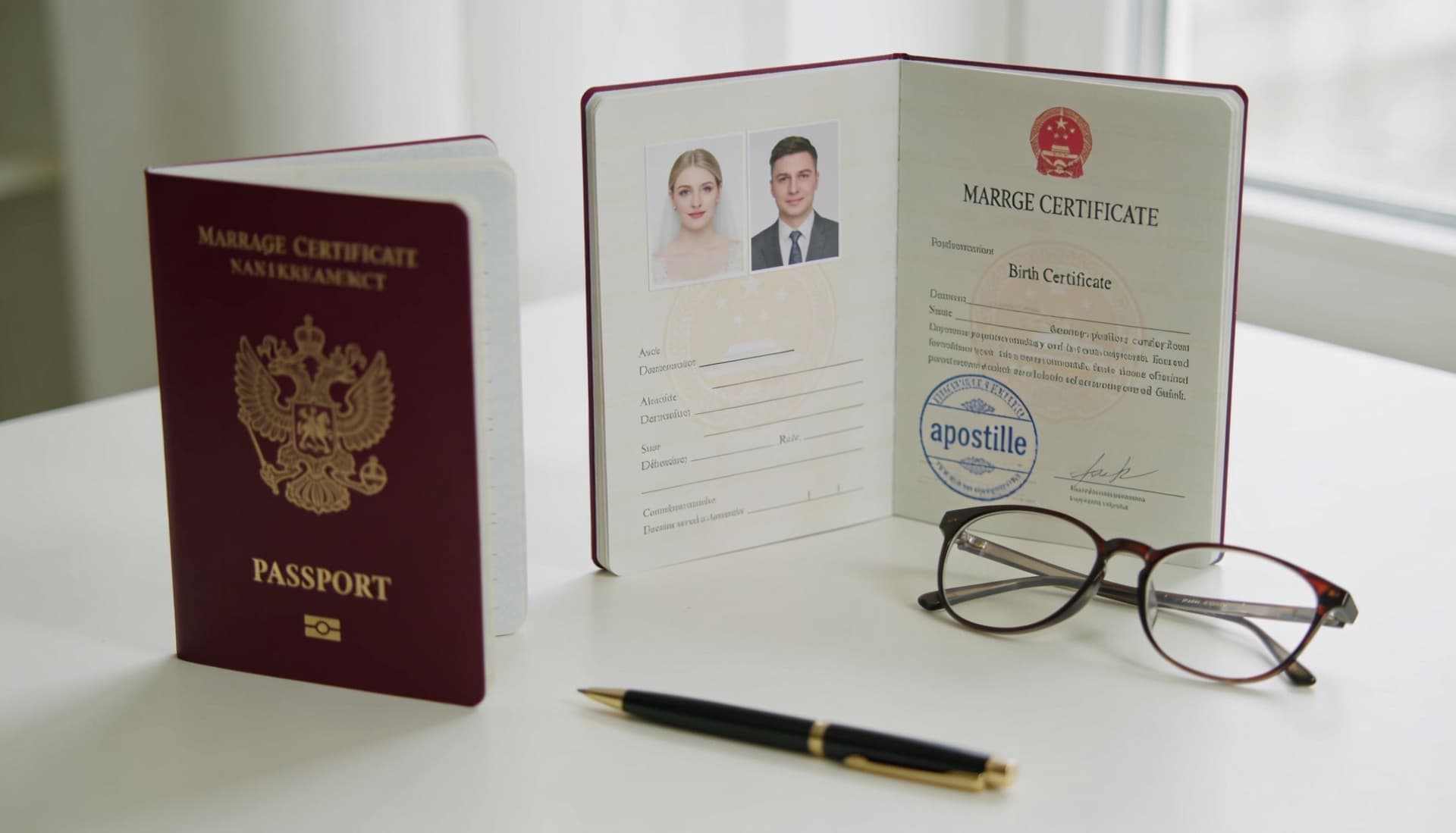
- Marriage certificate — officially apostilled or legalized depending on the issuing country, and translated into German by a certified sworn translator (vereidigter Übersetzer)
- Evidence of the German resident’s permit and current status (copy of residence permit, recent payslip, employment contract)
- Proof of accommodation in Germany (rental contract or landlord’s written confirmation)
- Proof of sufficient income (payslips and employment contract showing the German resident’s income covers both without recourse to public funds)
- Health insurance confirmation covering the initial period in Germany
Language Requirement for Spouses
For most spousal reunification visas, the applying spouse must demonstrate at least A1-level German language proficiency before the visa is issued. This means passing a recognized German language test at that level before the embassy appointment.
However, there are notable exceptions where the A1 requirement does not apply:
- Spouses joining EU Blue Card holders are fully exempt from the A1 requirement
- Spouses who can document that acquiring A1 German is impossible or unreasonable in their country (for example, where no language courses or test centres exist)
- Spouses of Niederlassungserlaubnis holders who fall under certain bilateral treaty arrangements
If the A1 requirement applies, register for an approved German language course well before the visa appointment — test slots can take several weeks or months to become available, and this step is commonly what delays the whole process.
Child Reunification — Documents Required
Children under 18 can generally join their parent or parents in Germany. The process and document requirements vary significantly depending on the child’s age and family situation.
Children Under 16
Children under 16 joining both parents (or a sole custodial parent) face the most straightforward process. Documents typically required:
- Child’s valid passport
- Biometric passport photo
- Completed national visa application form
- Birth certificate — apostilled or legalized, plus a certified German translation
- Custody documentation: if both parents are named on the birth certificate, either both parents must formally consent to the move or proof of sole custody must be provided
- Copy of the German resident parent’s current residence permit
- Proof of accommodation and sufficient income in Germany
- Health insurance confirmation for the initial period
Children Aged 16 or 17
Children aged 16 or 17 face a higher bar. They must generally demonstrate sufficient German language skills to integrate — typically at B1 level — or show they can integrate by other means, for example a confirmed school place in Germany. This requirement can be waived if it is not reasonable given the circumstances, but the default is that older children need to show language ability. Factor in preparation time and book language assessments early.

Reunification with an EU Blue Card — Key Advantages
EU Blue Card holders benefit from significantly more favorable family reunification rules compared to standard permit holders:
- Spouses are not required to demonstrate A1 German language skills before arriving in Germany
- Spouses can join from the date the Blue Card is issued — no minimum residence period applies
- Spouses of Blue Card holders receive an immediate right to work in Germany upon their arrival permit being issued, without a separate work authorization application
These advantages make the EU Blue Card substantially more attractive for professionals with families who want to join them quickly and begin working independently without administrative delay.
After Arrival — What Family Members Need to Do
Once in Germany, each family member must register their address (Anmeldung) at the local Einwohnermeldeamt, then visit the Ausländerbehörde to collect their Aufenthaltserlaubnis zum Familiennachzug (family reunification residence permit). Documents typically required at the Ausländerbehörde:
- Passport
- Biometric photograph
- Anmeldebestätigung (address registration confirmation)
- The sponsor’s residence permit or EU Blue Card
- Marriage or birth certificate (the same certified and translated documents from the embassy application)
- Proof of health insurance
The family member’s residence permit is typically valid for the same duration as the sponsor’s permit, or for up to three years, whichever is shorter. It can be renewed provided the sponsor’s own permit remains valid.

Processing Times and Common Delays
German embassy appointment queues for family reunification visas vary significantly by country. In some locations — India, Vietnam, the Philippines, Nigeria — waiting times for appointments alone can run to several months. Plan ahead:
- Book the embassy appointment as soon as the German resident’s permit is confirmed
- If A1 German is required, start language preparation immediately — do not wait for the appointment date
- Get documents apostilled and translated early — official translation and apostille processes can themselves take several weeks
- Verify that your marriage and birth certificates are accepted in the format required by German authorities — some countries issue these differently and additional authentication steps may be needed
A Note on Document Authentication
One of the most common sources of delay in family reunification applications is document authentication. Germany requires that foreign official documents — marriage certificates, birth certificates, custody orders — are properly authenticated before they are accepted.
- Hague Apostille Convention signatories: If the issuing country is a signatory, the document needs an Apostille stamp from the designated authority in that country.
- Non-signatory countries: The document may require full legalization through a chain of authorities — the issuing country’s foreign ministry, then the German embassy — which can be significantly slower.
- Translation: All documents not originally in German must be translated by a sworn German-language translator (vereidigter Übersetzer). Standard machine or unsworn translations are not accepted.
Exodo can help you understand which authentication path applies for your specific country and document type, and explain the contents of any official letters you receive during the process.
Frequently Asked Questions
Can parents or other relatives join me in Germany?
Parental reunification (Elternnachzug) is significantly more restricted and is generally only available for minors who are in Germany without their parents. Adult residents cannot typically sponsor parents under standard reunification rules, though limited hardship provisions exist. Extended family members such as siblings or grandparents are generally not covered.
Does my spouse need A1 German if I have an EU Blue Card?
No. Spouses joining EU Blue Card holders are specifically exempt from the A1 language requirement. Your spouse can arrive in Germany without pre-existing German language skills. Once in Germany, they can begin language courses at their own pace to support integration.
What if my marriage took place outside Germany? Is it recognized?
Germany generally recognizes foreign marriages, provided the marriage was valid under the law of the country where it was conducted. Polygamous marriages are not recognized. Foreign marriages must be documented with an officially authenticated and translated marriage certificate. In some cases — particularly marriages from countries with civil registry practices that differ significantly from Germany’s — the German authorities may request additional evidence of validity.
My child is 17. Do they need to demonstrate German language skills?
Generally yes — children aged 16 and 17 are expected to demonstrate sufficient German language skills or a credible path to integration. The B1 level is the typical standard, but the requirement can be waived if circumstances make it unreasonable. Contact the German embassy in your country early to understand the specific expectation, and consider registering your child for language classes as soon as possible.
Can my spouse work in Germany once they arrive?
For spouses of EU Blue Card holders: yes, immediately and without restriction. For spouses on standard family reunification permits: generally yes — the right to work is typically included in the Aufenthaltserlaubnis zum Familiennachzug — but confirm this with your local Ausländerbehörde, as specific conditions can vary.